Getting RFIs and submittals out of email threads


Somewhere in your inbox right now there is probably a question that is holding up a job. It was asked three weeks ago, four replies deep in a thread with a subject line about something else entirely, and the person who needs to answer it was dropped from the CC list two replies back. Nobody is lying to anyone. The system is just email, and email is where site questions go to die.
A request for information (RFI) is the formal process for raising and answering questions that resolve gaps, conflicts or ambiguities in project documents before or during the build. RFIs have been studied more than almost any other piece of construction admin, and the numbers are sobering. Navigant's Construction Forum analysed over a million RFIs across 1,300 projects worldwide and found the average cost to review and respond to a single RFI was around 1,080 dollars, with a median response time of nearly ten days.
Ten days to answer the average RFI, and roughly one in four never gets answered at all.
Think about that in site terms. An unanswered RFI is not a piece of paperwork, it is a crew that either stands still or guesses. Standing still burns programme. Guessing burns money, because guessed work that turns out wrong becomes rework, and industry studies trace nearly half of all rework back to exactly this kind of communication failure.
Why email makes it worse
Email feels like a system because everything is technically written down. But for RFIs it fails on the four things that matter.
- No status. An email thread cannot tell you what is open, what is overdue, and what is blocking work. Your open RFI list lives in the memory of whoever sent the emails.
- No ownership. When a question goes to four people, it belongs to nobody. Everyone assumes someone else has it.
- No deadline. Emails do not escalate. An RFI with a response date attached to it behaves differently from a message sitting quietly in an inbox.
- No record. When the dispute comes 18 months later, reconstructing who asked what and who answered when from six inboxes is somewhere between painful and impossible. A numbered RFI log with timestamps ends arguments before they start.

What a clean process looks like
You do not need enterprise machinery for this. A clean RFI process for a smaller contractor has five parts, and none of them is complicated.
One register. Every question that affects cost, time or design intent gets a number and lives in one list everyone can see. If it is not in the register, it does not exist.
One owner and one date per RFI. Every RFI names the person who must answer it and the date the answer is needed by, tied to when the work is programmed. A question that blocks concrete on the 14th needs an answer by the 7th, and the register should make that visible.
Context attached. The single biggest cause of slow answers is the responder having to ask a question back. Attach the drawing reference, the photo, the location. Ten extra seconds when raising it saves a week of tennis.
Pro tip
Write RFIs so they can be answered with a yes or a no. "Confirm door D-14 swings outward per drawing A-201" gets same-day answers. "Please advise on door D-14" starts a three-week conversation.
Chase from the list, not from memory. Overdue RFIs get chased on a rhythm, and the chase references the consequence: this is now holding first fix on block B. Polite, specific, relentless.
Close the loop on site. The answer has to reach the person doing the work, not just the inbox of the person who asked. However you run the register, the site crew must see the current answer next to the current drawing.

Submittals: the same disease, same cure
Everything above applies to submittals, with one addition: sequence. Submittals have chains, where the door schedule cannot be approved before the frame details, and email hides chains completely. Your submittal register should show what is submitted, what is approved, what is overdue, and crucially what is coming next, so the design team sees the queue rather than being ambushed by it.
The payoff is bigger than admin
Contractors usually digitise RFIs to save office time, and they do. But the real return shows up elsewhere. Faster answers mean crews that keep moving. A visible register means programme conversations happen from facts. And a complete, timestamped record means that when a job ends in an argument, you are the party with the evidence. One avoided dispute pays for a decade of good process.
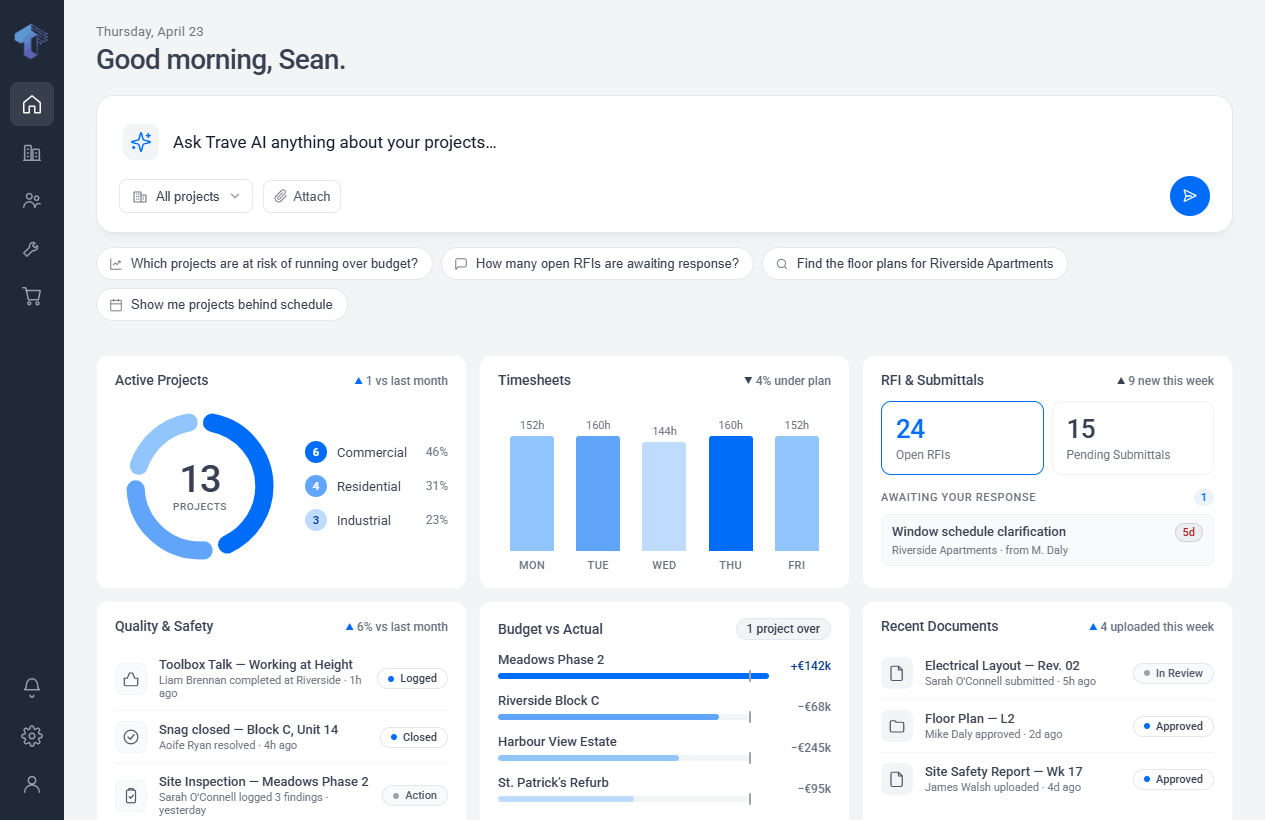
This is one of the workflows contractors most often move onto Trave first, precisely because the before and after is so stark: RFIs and submittals raised, tracked and answered in one place, tied to the project record, with nothing living in anyone's inbox. However you get there, get your site questions out of email. Ten days and one-in-four unanswered is the industry average. You do not have to be average.

Built for construction. See what Trave could do for your team.
Book a demo