How to choose construction software when you are not a 200-person contractor


Construction has a software problem that nobody building software likes to admit: most of it is designed for the top of the market. The demos are dazzling, the case studies feature contractors with ten-figure turnovers, and the pricing page asks you to book a call. Meanwhile the actual industry, in Ireland and everywhere else, is overwhelmingly made up of businesses with fewer than 50 people.
McKinsey has documented for years how construction underinvests in technology, historically spending under 1 per cent of revenue on IT, a third of what comparable industries spend. But there is a reason beyond conservatism: for a mid-sized contractor, most of what is on offer genuinely does not fit. Too big, too expensive, too long to implement. And the alternative, a patchwork of single-purpose apps, creates its own chaos.
Around 70 per cent of construction firms that attempt digital initiatives struggle to make them stick.
Having sat on both sides of this, here is the buying guide I wish more contractors had.
Start from your bottleneck, not from features
Software demos are designed to make you want everything. Before you watch a single one, write down the answer to this question: what is the one thing that, if it worked properly, would give me back the most hours or protect the most margin? For some businesses it is timesheets and payroll. For others it is document chaos on site, or invoices piling up unmatched, or never knowing job costs until it is too late.
Buy for that first problem. The right system solves your bottleneck in the first month and grows into the rest. The wrong system solves fifteen problems you do not have yet, badly.
The three-question fit test
Can my least technical person use it? Not your office manager. Your most stubborn foreman, on his phone, in the rain. If the answer is no, adoption will fail regardless of what the software can theoretically do. Ask the vendor to show you the exact screens a site worker sees, and count the taps.
How long until we see value? Enterprise systems talk in quarters of implementation. For a business your size the honest answer should be weeks. Ask specifically: what will be live in week one, and what does my team have to do to get there? If the answer involves a project manager on their side and a steering committee on yours, it is built for someone else.
What happens when we double? The tool that fits at 15 people should still fit at 40. Watch for pricing that punishes growth, per-seat models where adding every apprentice costs money, and systems that run out of road the moment you want job costing as well as timesheets. You do not want to run this procurement again in two years.
One platform or best-of-breed?
The classic trade-off. Single-purpose apps are each excellent at one thing, and collectively terrible at being a business system: five logins, five subscriptions, and no way to see labour hours against job budgets because those live in different tools that do not talk. Data re-entry is where the errors and the wasted hours live, and it is the exact problem you were trying to escape from spreadsheets.
All-in-one platforms trade a little depth in each function for the thing a growing contractor actually needs: one version of the truth, where hours, documents, orders and costs connect. My view, and yes, it is a self-interested one, is that below about 100 people the connected platform wins comfortably, because at that size you do not have the admin staff to be the glue between five systems. The glue is you, and your evenings.
Judge the vendor, not just the product
At this end of the market you are not buying licences, you are picking a partner. Some things to weigh that never appear on a feature list: Do they answer the phone, and how fast? Do their existing customers look like you, or are their case studies all ten times your size? Do they ship improvements monthly, and do those improvements suggest they listen to businesses your size? Ask to speak to two customers at your scale. A vendor who hesitates at that request has answered it.
Run the numbers honestly
Whatever a system costs, compare it to the real baseline, which is not zero. Your current setup costs you office hours spent retyping and chasing, payroll leakage that industry bodies put at 1.5 to 5 per cent of gross payroll, rework running at 5 to 9 per cent of contract value, and margin that leaks because costs surface weeks late. McKinsey's estimate is that digitising core processes lifts productivity 14 to 15 per cent. Against that arithmetic, most decent software is cheap. Against a baseline of zero, everything looks expensive.

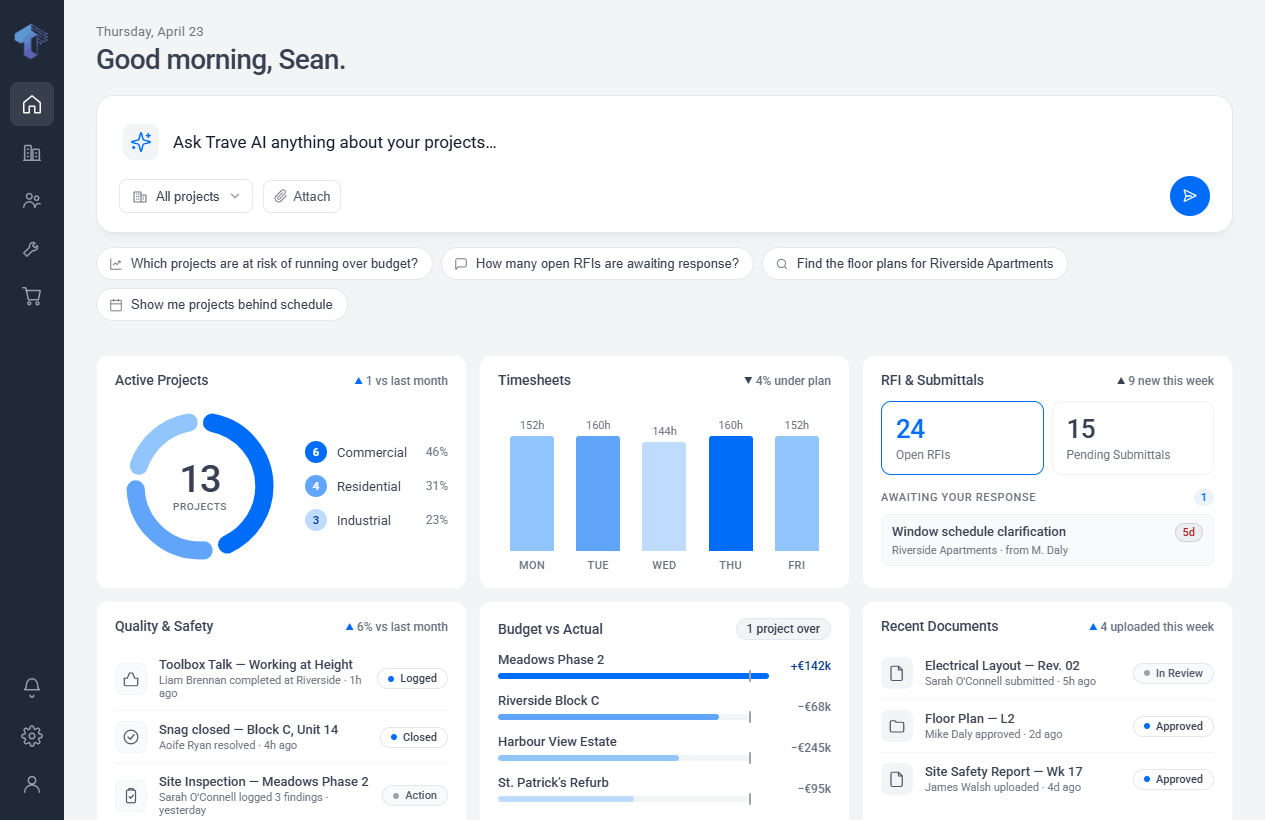
Full disclosure, obviously: Trave is one of the options in this category, built specifically for contractors who have outgrown spreadsheets but will never need, or want to pay for, an enterprise platform. Whether you look at us or not, the advice stands. Buy for your bottleneck, test with your hardest user, insist on weeks not quarters, and pick a partner who knows businesses your size. The right choice feels less like buying software and more like hiring a very cheap, very tireless back office.

Built for construction. See what Trave could do for your team.
Book a demo