The real cost of running a construction business on spreadsheets


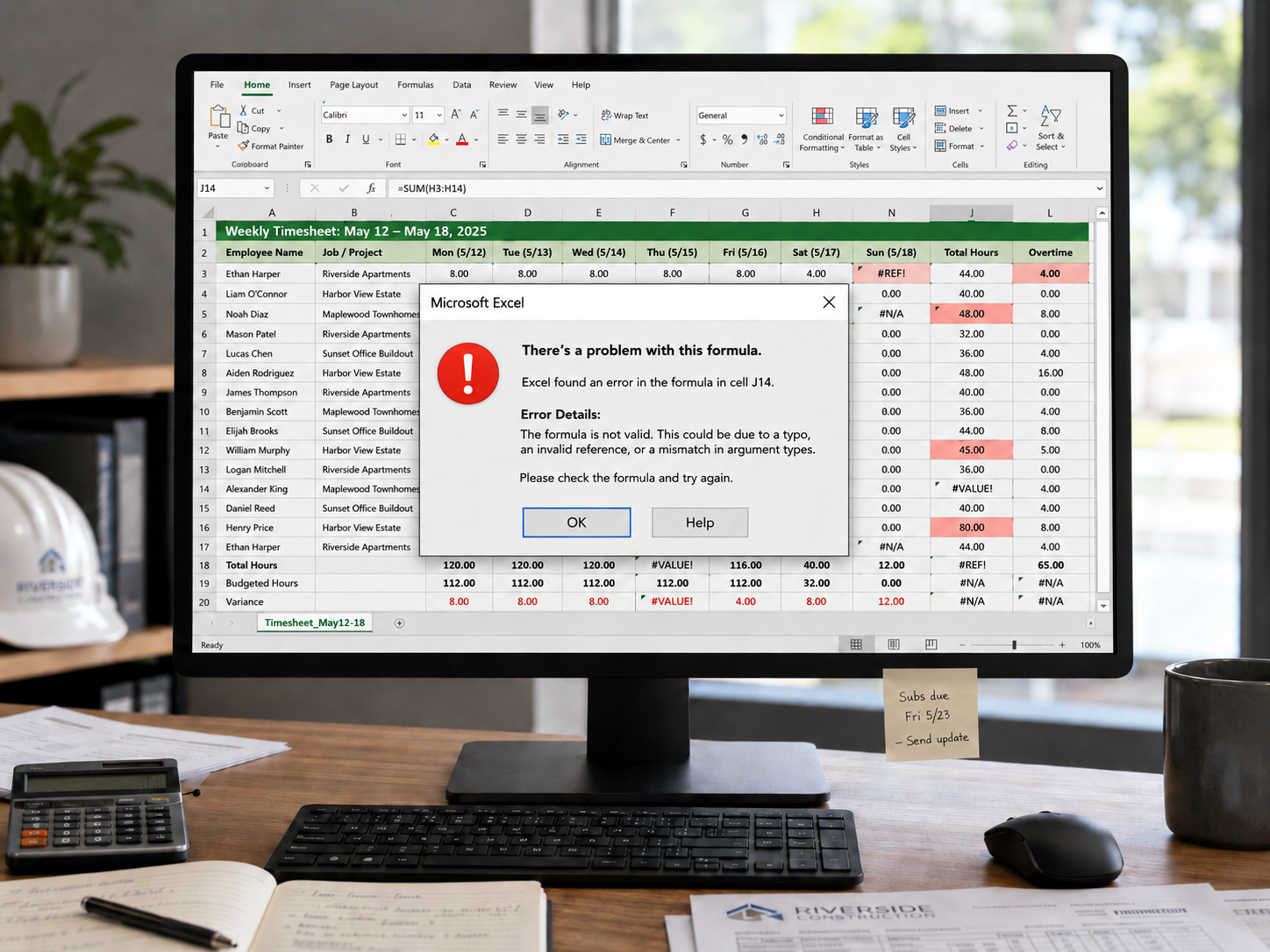
Almost every contractor I speak to runs some part of their business on spreadsheets. Timesheets in one file, the project budget in another, a price list somewhere else, and a folder of versions nobody fully trusts. It works, sort of, right up until it doesn't.
The problem is that spreadsheets feel free. There is no invoice for them at the end of the month, so the cost never shows up anywhere you can see it. But the cost is real, and for a business running several live jobs it is usually bigger than any software budget would ever be.
The hours nobody counts
Research by FMI and PlanGrid put numbers on something most of us already felt. Construction professionals spend around 35 per cent of their working time on things that add nothing to the job: hunting for project information, resolving avoidable conflicts, and dealing with mistakes and rework. That is roughly 14 hours a week per person, with about 5.5 of those hours spent just looking for project data.
14 hours per person, per week, goes on work that adds nothing to the job. Five and a half of them are spent just looking for information.
Think about what that looks like in a 20-person business. A site manager rings the office because the programme he has is two revisions old. Someone in accounts retypes docket details into a costing sheet. You spend Sunday evening pulling four files together to work out where a job actually stands. None of it appears on a profit and loss statement, and all of it is paid time.
Errors that compound quietly
The second cost is worse because it hides longer. The same research found that poor communication and inaccurate or inaccessible information account for nearly half of all rework in construction. Depending on the project, rework typically eats 5 to 9 per cent of total contract value. On a 2 million euro job, that is 100,000 to 180,000 euro of work you effectively do twice.
Spreadsheets are a rework machine because they separate the information from the work. The estimate lives in one file, the actuals in another, and the person on site sees neither. A price gets updated in the estimating sheet but not the ordering one. A retyped number loses a zero. Nobody notices for six weeks, and when they do, the margin is already gone.
The blind spot at the top
The deepest cost is what spreadsheets do to decision making. When your job costing lives in files that are updated weekly, or whenever someone gets a chance, you are always looking at the past. You find out a job lost money after it finishes, when the only thing left to do is promise yourself the next one will be different.
Ask yourself one question: if I picked one of your live jobs right now, could you tell me its committed spend against budget, today, without opening five files and making three phone calls? If the answer is no, you are not really controlling costs. You are recording them.
Why we all end up here anyway
None of this happens because anyone is careless. Spreadsheets are how growing contractors survive. When you are five people, one workbook genuinely is the right tool, and the habits that got you to 15 or 30 people are hard to argue with because they worked. The trouble is that spreadsheets scale by adding more spreadsheets, and every new file adds another version of the truth.
The tipping point is usually not dramatic. It is a busy year. A second or third simultaneous project. A new hire in the office who cannot read the estimating sheet the way you can. Suddenly the system that lived in your head needs to live somewhere everyone can see it, and a folder of files cannot do that job.
What to do about it
You do not fix this overnight, and you should not try. But there are three moves worth making whatever tools you use.
- Pick one source of truth per question. Whatever holds your labour hours, your project documents and your job costs, there should be exactly one place for each answer, and everyone should know where it is.
- Capture information where the work happens. Every retype between site and office is a delay and an error waiting to happen. Hours, dockets and site records should be recorded once, at the source.
- Review costs weekly, not monthly. A cost problem found in week two is a conversation. The same problem found at month end is a write-off.
The industry is slowly waking up to this. McKinsey's research on construction productivity found that digitising core processes can lift productivity by 14 to 15 per cent and cut costs by 4 to 6 per cent, which for a business doing a few million a year in turnover is not small change.
Full disclosure: this problem is why Trave exists, and helping contractors out of spreadsheet chaos is what we do all day. But whether you ever talk to us or not, count the real cost of your spreadsheets honestly. The number is bigger than you think.

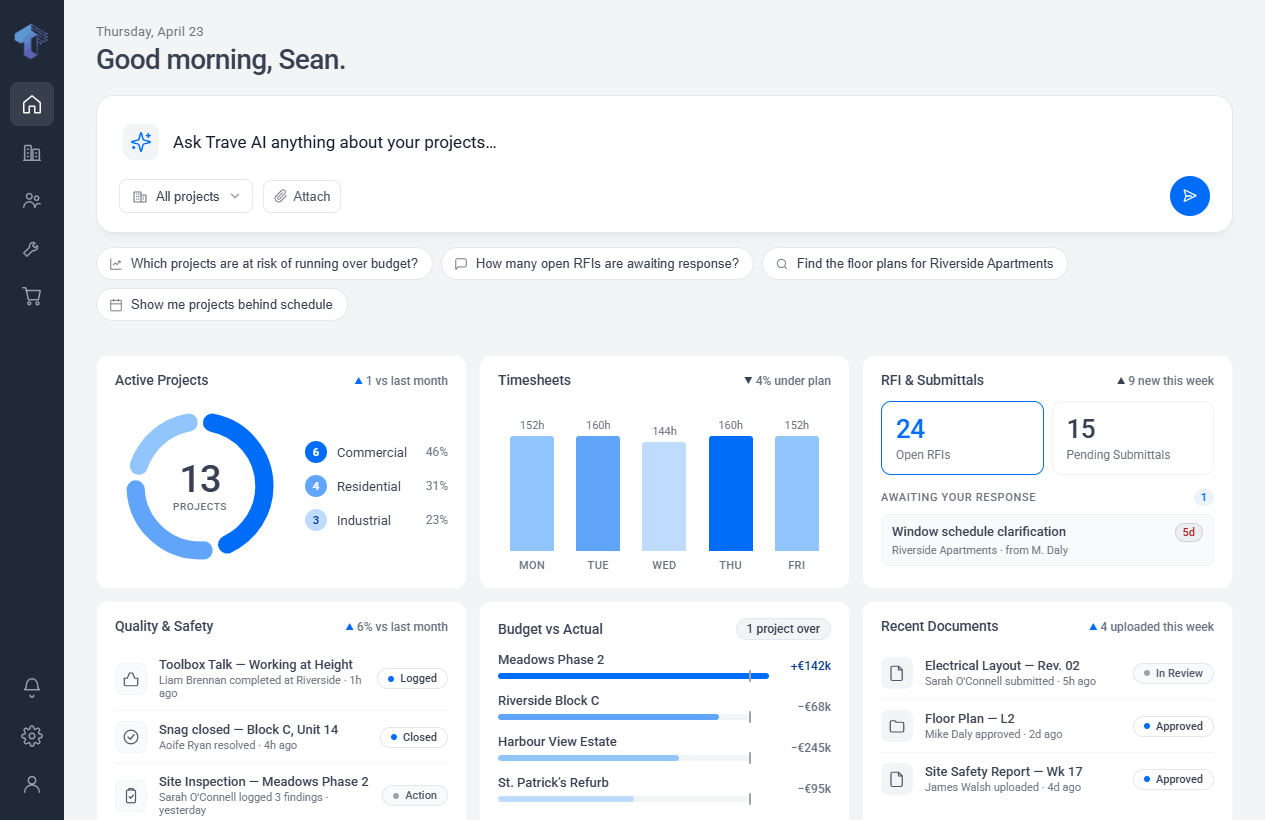
Built for construction. See what Trave could do for your team.
Book a demo