Where construction margins actually leak, and how to catch it before year end


November is when contractors find out what kind of year they actually had. The accountant starts asking questions, the jobs that felt busy all summer get their final numbers, and somewhere in there is the annual mystery: we did more work than last year, so why is there not more left over?
The uncomfortable truth about construction margins is that they rarely disappear in one big hit. A disaster job announces itself. What kills more businesses is the quiet stuff, the two and three per cent leaks on every job that nobody sees until the work is done. In a sector where net margins for smaller contractors are often thin to begin with, and where insolvency lists are dominated by small and specialist firms rather than household names, those leaks are the difference between a good year and a dangerous one.
Here are the five leaks I see most often, and what catching each one early looks like.
1. Labour drift
Labour is the biggest number on most jobs and the least watched. The estimate assumed 400 hours for first fix; nobody ever compares the real figure until the job closes, if at all. Hours drift 10 or 15 per cent over on task after task, each small enough to shrug off, together enough to erase the margin.
The fix is not more pressure on the crews, it is faster feedback. If hours are logged daily against cost codes, a drifting task shows up in week one. Catching a 60-hour overrun with a third of the job left is a management decision. Catching it at final account is history.
2. The gap between committed and spent
Most contractors track what has been invoiced. Far fewer track what has been committed: the POs raised, the orders placed, the plant on hire that has not been billed yet. That gap is where budgets quietly die.
A job can look 10,000 euro under budget on invoices while sitting 30,000 euro over on commitments.
If you do one thing after reading this, make it this: track committed cost against budget, not just invoiced cost. It is the single clearest early warning a contracting business can have.
.png)
3. Uninvoiced variations
Every builder knows this one and almost everyone still bleeds from it. The client asks for a small change, your foreman is decent and gets it done, and it never becomes a variation order because everyone was busy and it felt petty to paper it. Do that twelve times on a job and you have given away a week of work for free.
The rule has to be boring and absolute: no instructed change gets built without being recorded, no matter how small. A photo, a line of text and a number, captured on site the day it happens. The contractors who do this well are not the pushy ones, they are the organised ones.
4. Rework
Industry studies consistently put rework at 5 to 9 per cent of contract value, and research by FMI and PlanGrid found that nearly half of it traces back to poor communication and bad or inaccessible information: the crew building off the old revision, the spec question answered on a phone call nobody wrote down. On a 2 million euro turnover, even the low end of that range is 100,000 euro a year spent building things twice.
Rework is not a quality problem first, it is an information problem first. One source of truth for drawings and documents, with RFIs tracked outside email and everyone on site looking at the current version, removes the largest cause of it.
5. Slow money
Margin on paper is not margin in the bank. UK government figures put the cost of late payments to the economy at over 11 billion pounds a year, and research on subcontract payments has found late payment in nearly half of all payments studied, with retentions released almost two months late on average. Meanwhile you are paying wages weekly, whatever the client's payment run says.
Watch your applications and retentions like you watch your jobs. Invoice the day you are entitled to, chase the day it is due, and know your retention dates without looking them up. Cash discipline will not fix a bad margin, but plenty of profitable contractors have gone under waiting to be paid for good work.
The pattern behind all five
Notice what these leaks have in common. None of them is a pricing problem. They are all visibility problems: information that existed somewhere, too late to act on. That is why the fix is rarely working harder and usually seeing sooner, whether that is a weekly budget versus actual review, committed cost tracking, or site records captured the day things happen.
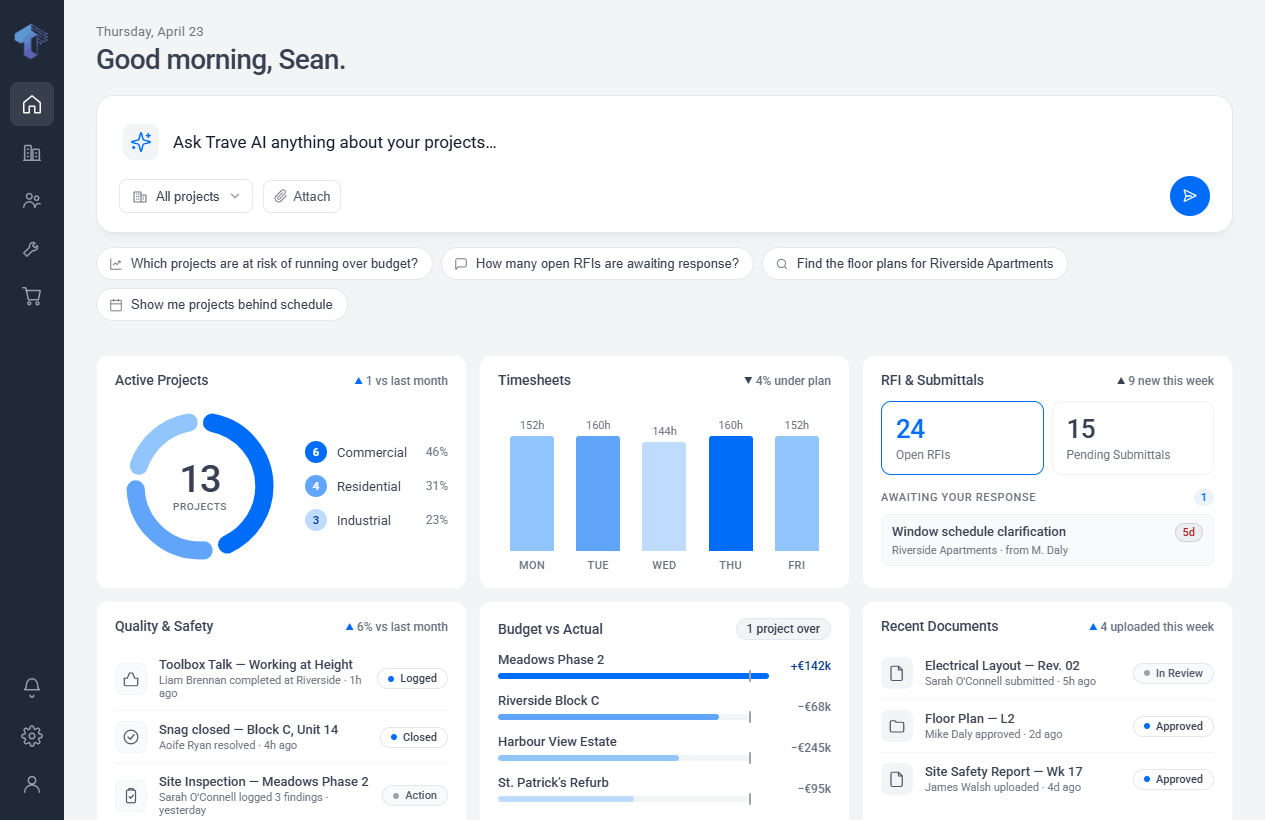
This is the problem Trave was built around: live cost against budget on every job, so the leak shows up while you can still plug it. But whatever you use, go into January knowing where last year's margin actually went. Most contractors never find out, and that is why it happens again.

Built for construction. See what Trave could do for your team.
Book a demo